
Of Chivalry and Blood
For what is honor but the doom of honorable men?
A short story by EM Levine
The rising sun slowly banished a heavy fog from a sweeping, grassy plain, where the stench of death hung thick in the air. Upon that plain, the dead were innumerable. Countless men hacked of limb and head, thrust through with spear and javelin, fallen to a squelching bog of crimson mud. Once proud banners were splintered and shredded on a folde of corpses, the handsome richness of blue silk and scarlet satin tainted alike by the muck of the earth. Though they lay tangled together wherever the eye turned, one thing was evident: to the isles of red, the blue was as an ocean.
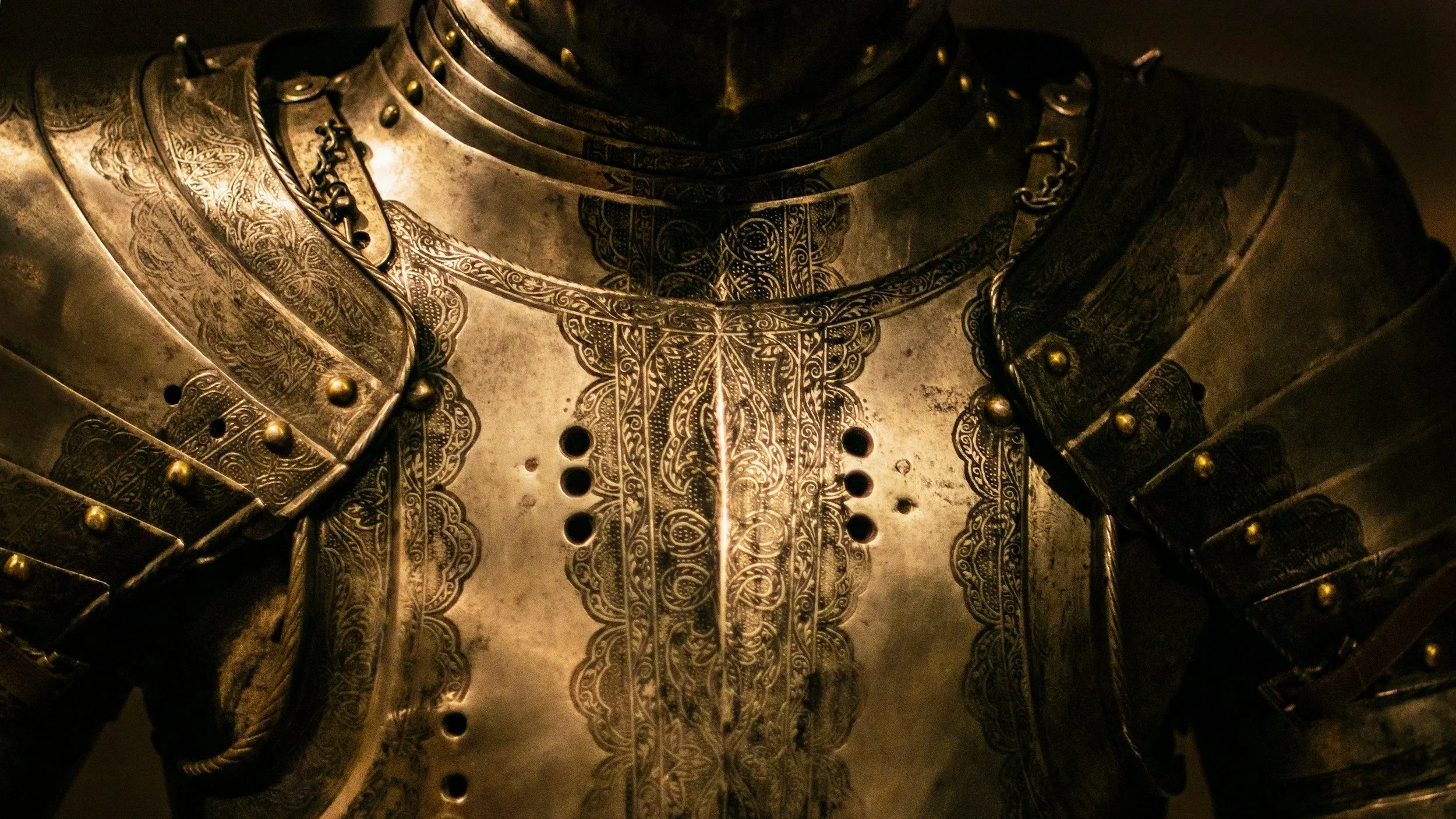
Across the fester and death strode a single knight. His every footstep was a heaving effort as the bulk of iron plates weighed him down, shin deep in the mud. Groaning, he dragged himself free again and again, only to sink further back into the quagmire. The regal coat of arms upon his breastplate was obscured by a smattering of gore. His left arm hung useless at his side, and his right glove was clenched around the hilt of a broken sword. Mud and viscera dripped from his visor, obstructing his vision, and the grand blue feather on the crest of his helm was a tattered mess.
Step after step, he marched on, his head turning to neither side to regard his fallen comrades. With a sucking slurp, the ground swallowed one foot. With a sticky rasp, it released the other. His mail and plate rattled, the only sound save the whipping of the wind. Where once had rung the mighty battle cries of valiant men, prepared to die for king and country, now there was an empty silence to which his clanking, sloshing progress struck a sinful offense.
The ground sloped up, from valley to hillside. There, the object of his march: a wooden table in the grass, and a pair of chairs on either side. Beside them, a flanking pair of knights, their armor polished and pristine. Behind them, a cloaked advisor, poised with quill and scroll. Seated in one of the chairs, a young man clad in armor polished to a mirror shine. His helm resting by his arm bore a three-foot, scarlet feather to match the emblem on his pauldrons. He watched the other’s progress with unmistakable glee, a wild smile on his handsome lips, his sharp eyes flashing.
None of them said a word. None of them moved a muscle. They simply watched, in breathless expectation, as the bloodstained blue knight made his way through the desolation.
Until he stopped, by the arm of the vacant chair, his breathing heavy and his shoulders sagged. Until he removed his helmet—beneath it, a face of youth akin to his enemy’s, but lined with grief and loss, caked with dirt and grime, wearied beyond expression—and set it down beside the other. Until he sat himself in that chair, in exhausted resignation.
Then, the red knight snapped his fingers. The sound echoed across the valley. At once, his advisor laid the parchment, the quill, and a pot of ink on the table. The red knight slammed his hand down on the parchment with a ringing of his gauntlet, his finger poised on the vacant line at the bottom of the page, a line upon which all eyes suddenly fixed.
The blue knight stared at the empty line yawning up at him, lacking only his signature to be complete. He glanced at the quill, poised ready with its sharp tip in the pot of ink. He looked back towards that field, where men and armor and horses lay strewn and broken. Then his breath came in a great sigh, and he spoke in a low, gravelly voice, worn and hoarse from hours of shouting.
“Tis said a single act of greatness can outmatch a thousand thoughtless deeds.” He looked again to the parchment before him, where the other’s finger was now tapping that vacant line. “Had this ink been penned, would we not have come to this?”
“Twas your own pride and arrogance that saw it was not so, Geoffrey,” the other grinned. “This is all your doing!”
“My doing,” the blue knight sighed, shaking his grizzled head. “We sit here on the field of battle in place of kings who are miles from here, sat at table with their ladies in finery, breaking their fast with bread and ale, eagerly awaiting the latest news of this conflict, a conflict for which they will claim credit, or lay blame. Yet they fought not. They died not. For them and their ambitions, their aims, we now lay bathed in the blood of our brothers.” Geoffrey met the other’s eye. “Tell me, Guillaume. Was it truly worthwhile?”
“Spoken like the loser to the victor,” the red knight laughed heartily. “To every man of scarlet upon this field, I see twenty fallen of blue! Your army lies in wreckage while mine stands ready to march on. The feebleness of your cause is made evident by the enormity of your failure.”
“And what of your cause, Guillaume? What do you gain from so much loss?”
“The ending of you and your backwards ideas!”
“Our ideas? Were such ideas a threat to you and yours? Did they afflict you by night and haunt you by day while here within our own lands they flourished?”
“These are our lands by birthright! You are usurpers! Your king is a pretender! Your time here is naught but a mere farce!”
“And did you not walk these lands freely when there was peace between us? Did you not enjoy the bounty of this land when we were brethren? I say again, Guillaume! What have you gained by all this death?”
“We shall rule over you now! You shall be subject to my king!”
“Ah, yes. So, we trade one king for another. And one day, he too shall be replaced. Kings will rise and fall within the walls of their courts, while men die by the thousands out on the fields in the name of their pride.” To the field of blood, he turned again, a tear in his eye. “I knew these men as my own brothers, and to others each was kin. Every one of them. Now, they are all gone, and there is no joy, no happiness. Only weeping and gnashing of teeth, of loved ones robbed, of friends made sorrowful, of places left empty at tables, of children without fathers.” He turned back to his enemy. “Did you know none of those who died today in such a way, Guillaume? Will you not weep for them? Does the pain of their loss not make sour the toast of victory?”
“What manner of jest is this?” Guillaume laughed. “A knight with no chivalry? No valor? Who scoffs at noble sacrifice in the name of king and country?”
“Noble? Is this nobility? This fog of death and filth? Show me the nobility in the faces of the fallen. Show me the chivalry in those drowned in the mud. The valor in those who were thrown down and beaten to death with pommel and hammer. What nobility is there in this work of debauchery and defilement, that men should rend each other from life so relentlessly?”
“There is no comfort for those who fall, Geoffrey. No comfort in defeat. You have lost. Your men have lost. Your king has lost. Your only sacrifice is the watering of this earth with your blood, to one day sprout forth trees in your place. Ours is the reconciliation of wrongs righted. The repayment of innumerable slights. It may be easy for you to speak of forgotten peace, when you see your country slipping away, but we whose country’s heart still beats strong hold to our beliefs! We do not sway! We do not discard them on the backs of our failure.”
“Slights and wrongs? Which man among these offered you slight or wrong? Which of these, Guillaume, upon whom you have taken your revenge? I ask you, why not seek the one who offered the offense than slaughter so many? I wonder often if to duel between parties would divest the world of such suffering.”
“I say! This is good! You would rather your king have dueled ours than met us in battle?” Guillaume exclaimed boisterously. “He would have fallen like a sack of spuds, the old codger.”
“Then one man would have fallen, and a thousand would be spared. One house would lay aggrieved this night rather than countrysides echoing with wails. Truly, Guillaume, I charge you to account for it: for what purpose are we here, spilling the blood of those who would be our brothers? For what purpose have we rent so many families asunder? For what purpose, man? Why? What have we gained or lost beyond that which all men solely crave: to live?”
“Your words do carry truth, Geoffrey. You have gained and lost nothing more than life. Nothing that was yours to have or to hold. We, on the other hand, have lost only lives and gained everything else. The land that is ours. The goods that are ours. The right to live and rule where we ought. The right to toast our king in taverns that were stolen. The right to harvest crops in fields our ancestors sowed. The right to worship in our churches and speak in our tongue and dance in our halls. And had your king but signed this document with his own hand when our emissaries delivered it to him in his gilded halls—had he signed it when we sailed across the ocean in our fleets and landed upon your shores to show the seriousness of his offense—had your commander signed it when we met upon this field yestermorn when all of us sat at campfire eating mutton and toasting ale…then that field would not be littered with the bodies of a thousand men, the countryside might not be in mourning, and all of this might have been avoided. But it was not so. So, to war we come.”
“To war we come,” Geoffrey sighed, his head low. “All that blood spilt, from great and valiant veins, all for a few drops of ink, spilt from one tiny cup.”
“Yes. Indeed,” Guillaume grinned. “Now then…”
He thrust the parchment forward and put his finger to the vacant line once more.
Geoffrey took up the quill. The joints of his gauntlet creaked with grimed impediment. He dipped it into the dark ink and scrawled upon the parchment, on that empty line, the signature of his birth. With a few strokes of the pen, he made the mark. The mark that could have spared a thousand lives, for which a thousand had fallen, all now for naught.
Guillaume stood and clapped his hands. “Excellent!” he said. “Your penmanship is of excellent form, brother.”
And from his side he produced his sword and drove the other straight through.
Geoffrey gasped, and his gasp carried blood. Blood which sprayed the parchment, marking it with life as well as ink. He slid out of the chair and onto the ground, and Guillaume wiped his sword clean with a rag. He threw the rag down and snatched up the parchment. Then, he turned his back on the field of death with but a passing word to his flanking guards.
“Leave not one alive.”