
The Warrior and the Baal’ash Tree
A short story by EM Levine
Atonement takes a lifetime
Upon a vacant, lonely hilltop lay a sparkling sheet of dewdrops. The soft breath of the breeze carried with it the twittering melodies of songbirds far and wide. Beneath a cloudless, open sky, the light misting of fog scattered dawn’s light over a pristine hollow.
Almost pristine.
At the apex of the hilltop, the grass blanket was marred by a perfect circle of exposed, dark earth about a meter wide. Nothing grew there save a single shoot no taller than a finger. Encompassed by the grasses, it was like a lone soldier surrounded by a conquering army, yet the patch of earth remained inviolate, the tiny shoot standing.
This was no ordinary shoot. Its stalk was metallic, its minute leaves glistening with a mother-of-pearl sheen. It was, to the common eye, an anomaly, a growth of living metal fluttering delicately in the wisping air, equally strange and lovely to behold.
As it was no ordinary shoot, it was no ordinary young man who came trudging up the hillside now towards it.
He was tall, taller than any normal man, but not broad. His impressive height was measured by catlike leanness and sculpted athleticism. In the crisp morning chill, he wore only a simple brown tunic, the otherwise concealed scars crisscrossing his upper arms livid on his cold skin. He walked with commanding purpose and disciplined stride. His hard face showed many miles traveled, and his vacant, haunted eyes were those of a warrior.
No pack nor walking stick did he set down as he stopped upon the hilltop. The imprints of his feet in the dew marked his path, as if the ending of some great journey. Gazing into the rising light, he drew a long, slow breath. Then, he knelt, as though in prayer, and cradled the shoot’s tiny leaves with a tenderness entirely uncharacteristic of one so shaped for violence.
Satisfied with his examination, he stood again, went a short distance away, sat back on his haunches, crossed his legs, folded his hands, and closed his eyes.
And there, upon the hilltop where the tiny shoot grew, he remained.
The day waxed hot. The sun beat down on his exposed neck, shoulders, and arms. He perspired and his skin burned. Nonetheless, he remained, unmoving.
In the early afternoon the birds flew low over the tiny, lonely shoot, the covetous gleam in their beady eyes unmistakable. When they came close, he arose and shooed them away with vigorous anger. Then they scattered until none remained.
Night fell heavy over the still land. Still, he showed no signs of moving from his place. Stars twinkled bright against the black canopy above as he lay upon the grass right where he sat. There he slept, undisturbed by evening’s chill or the night’s creatures.
Dawn broke the next morning, and he was gone. Not a trace remained but the imprint of his body in the dew. The birds came circling again, and the deer of the field strayed close to where the shoot grew. It seemed for the moment that its end might come quickly.
Suddenly, the beasts scattered as the trees of the foothill stirred. From the branches and bramble, he emerged. Stained from head to toe in crimson blood he was, gore caked thick in his fingernails and the glint in his eyes that of a savage predator. The embodiment of barbarity, he lumbered slowly up the hill and crouched there to lick the dew from the grass. Then, slaked by whatever wild feast he’d hunted, he sank once more into silent serenity.
Again, the whole day he remained. Next morning, he left again and returned, cleansed of viscera. Another day he waited, all day long. So it continued, day after day, night after night.
When the sun was hot, the patch of soil baked dry. Then he brought a vessel of bark to douse it in clear water. When the rains fell heavy, he fashioned a lean-to of branches and took shelter beneath it. Some days, the winds blew so fiercely that his shelter was blown away. The storms raged as if angry at his stoic presence. Defiantly he remained, through it all, until the rain and thunder ceased and he remained, unmoved.
Every few days, he came bloodied and bruised. Now and then, he came with nothing but a beleaguered scowl and the groan of aching hunger unsatisfied. By the way of the beasts, he sustained himself, as though kin to the wolves that stalked him at night. Stalked they did, but did not come near, even when he slept. Instead, they lay afar off, watching with care, as though wary themselves, as though he were more predator to them than kin.
Time stretched into weeks.
Into months.
Into years.
His cloths grew ragged. His hair long and wild. Still he stayed, watching over that tiny shoot, as it stretched and began to grow tall and strong.
In time, it was tall enough to sag, its weight too great for the thin stalk to bear. That day, he built a support of branches for it and formed a ring of smooth stones around its base, gathered from the banks of the nearby brook. Every week hence the stalk grew taller, and every week hence he added another stone, until at long last the stalk grew bark and stood straight on its own. He removed the supports but still kept adding to the ring of stones.
The branches spread, and he came to lie beneath it. With pails of hollow stone and wood he watered it, and with sharpened rock he trimmed its branches. So branch by branch it grew, until it became a tree.
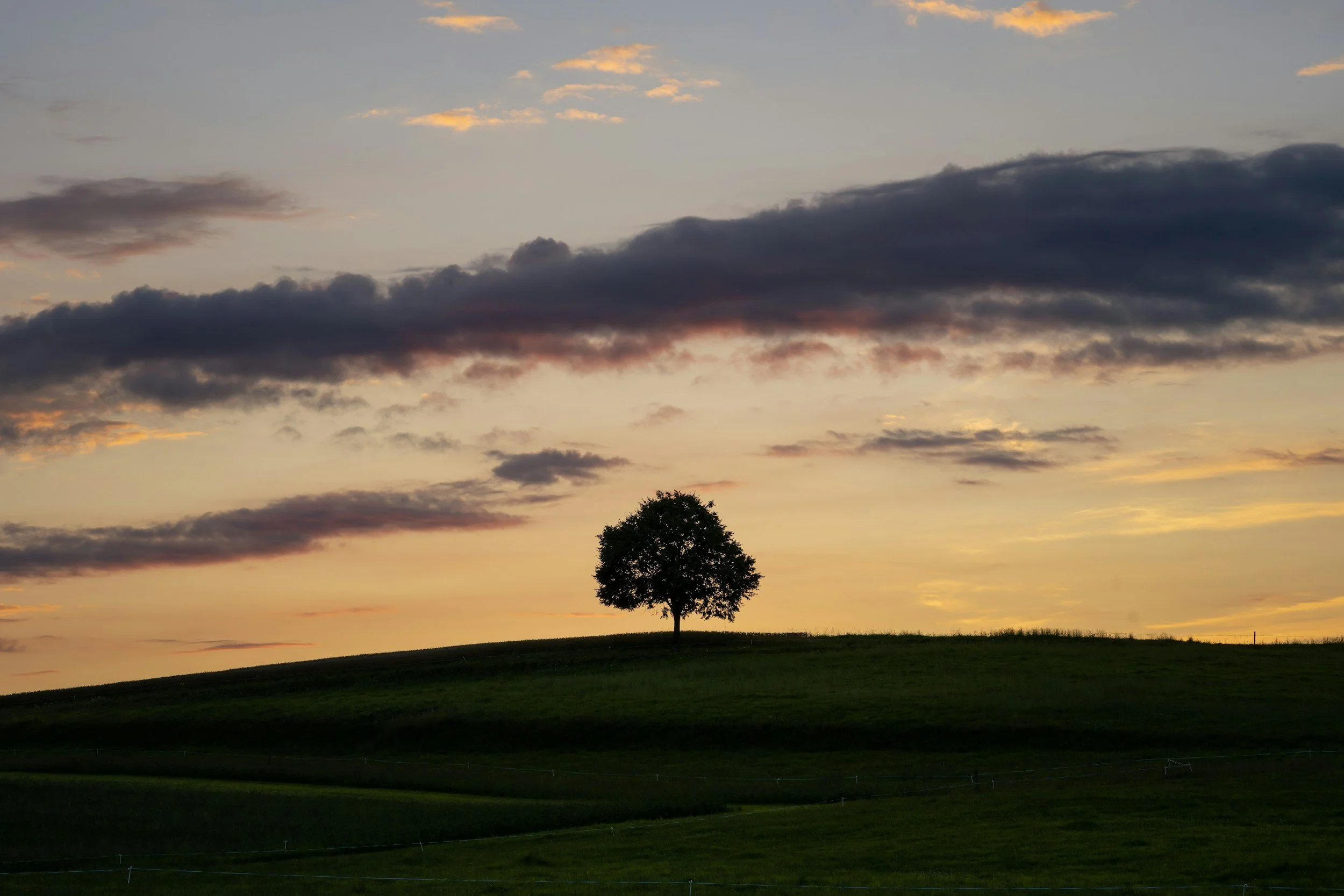
A handsome tree it was, with wood both dark and bright, marbled like living stone laced with ore. Its leaves bloomed rich and vibrant, a lilac more lovely than flowers or gems. When spring came, it sprouted sweet-smelling flowers dripping with amber nectar. This he drank from its delicate petals, as did the birds who came now to nest in what once they would have consumed. Soon, the tree grew to dominate that lonely hilltop, a solitary giant on the empty landscape.
And still, he remained.
Upon a hilltop, no longer vacant, came the tread of unfamiliar boots. Where once had walked but a single pair of feet, now there came another. They trod on the grass, pressing it down with the weight of worlds that their bearer carried. Towards the singular tree high upon the hill they marched and reaching it they stopped.
There the tall man sat. He was young no longer, but not yet old. His eyes were closed, his breathing even, and his palm pressed flat to the ground.
The newcomer stopped short, his breath caught in his throat, the surprise in his face plain. The tall man spoke first, with no surprise whatsoever.
“You still list to the right.”
The shadow of a smile ghosted the newcomer’s face, but no laugh answered the friendly critique. The shock ebbed from his expression, replaced by hard calculation.
“No instruction,” he said in reprimand. “No word. No trail. You just…left us.”
“I had a feeling you’d find me eventually.”
“You couldn’t’ve known!”
“And yet, here you are.”
Seemingly speechless, the newcomer turned to appraise the towering tree.
“It grew,” he observed, impressed.
“Took three years to find the right place,” the other answered.
Another sharp huff from the newcomer’s lips, and a glance of distaste, or misunderstanding.
“You didn’t have to do this!” he burst out.
“Didn’t I?” wondered the other.
“There were other ways! Less extreme ways. What did you think this would accomplish?”
“What you mean is no one will accept an archaic rite like this as my penance.”
“Is that why you did this? To pay penance to them?”
“No. To pay penance to me.”
Once more, the newcomer had nothing to say. The tall man turned where he sat to face the visitor, opening his eyes. In them was a hollow emptiness, a darkness beyond light.
“Everything I did…I see it now. The folly of it. But it’s too late. It’s how I’ll be remembered. The history books will call me a tyrant—conqueror, monster—and they’ll curse my name. That’s my legacy. After all I did to save them, in the end I’ll be known as their worst enemy.”
“Worst? You think they’d hold you equal to him?”
“No. I think they’ll hold me worse. He was always their enemy. I was an enemy that came in trust’s clothing.”
The tall man stood and put his hand to the tree. He ran a hand down its smooth bark and breathed in the scent of its flowers.
“This tree lives because of me. It’s the one thing I’ve given to and taken nothing from. The one thing I haven’t hurt. If pain is my legacy, at least one thing will live on where my Echo is bright, not dark. I did this for me. Because I had to.”
“Right. And that’s why you just left all of us. Because you had to.”
The tall man stiffened. “Of course you wouldn’t understand…”
The newcomer scowled. “You’re wrong, you know. There was already something where your Echo was bright. And you gave it up.”
The tall man’s fingers contracted on the tree.
“So, she sent you.”
“No. I came myself. She’s still right where you left her.”
The tall man’s shoulders sagged then. “How—how is she?”
“Good to hear you care at all,” the newcomer sneered. Then, when there was no response, “She’s fine. Still waiting. For you.”
The tall man’s hand clenched into a fist. “She’d do better to forget me.”
“As if she could!”
“She owes me nothing!”
“Is that what you think? That she followed you because of duty? You think any of us did?”
“I don’t want to know why you all let me lead you into ruin and disrepute!”
“Then you haven’t learned a damn thing.” The newcomer shook his head. “Ten years you’ve been hiding here…”
The tall man whirled with a flash of hate. “Do not tell me what I’ve learned! You think I’m hiding? That I ran? You know nothing of what I’ve done!”
The newcomer smirked, entirely unfazed by the anger. “There’s my old friend. Just as stubborn and stupid as always.”
The tall man turned away, his head hung.
The newcomer followed. He put his hand on the other’s shoulder. “It grew. You’ve done what you meant to. Come back with me now. Leave your sins and sorrow here and come home.”
“Now I know she sent you. Only she would think I’ve still got a home to come back to.”
“She won’t stop, aavhen. She’ll just keep waiting.”
“How—how can I even face her?”
“Because. You have to.”
Then the newcomer reached back and drew from his pack a long, gleaming staff of solid bronze. This held out to the tall man, who at first regarded it with recognition. Then, with disgust. Then, with longing. And finally, with steeled resolve.
“No,” he said. “I don’t need it anymore.”
The newcomer beamed. “Then leave it here too.”
So, the tall man laid the bronze staff at the tree’s magnificent roots. There he left them both and departed with his friend, the fruits of his life’s two greatest labors left to rest: a weapon of wonders, and a blooming baal’ash tree.
And there it remained for ten thousand years. Generations passed, the landscape shifted and changed, but never did it fall. Never did it falter. Ever it stood, tall and grand, and ever upon its roots the bronze staff lay, twin relics of a lost man found.
Ten thousand years passed, those passing by the hilltop would claim to have seen him, caught in the beam of daylight, laughing merrily, a kind-faced woman and a child with his smile dancing with him, round that lonely baal’ash tree.
There upon the lonely hilltop.